What Disengaged Students Are Really Telling You
Education professionals, you’ve probably heard it a thousand time: “I’m good.” I’ll do it later.” “School is not for me.”
They are the myriad things that students say when education professionals are trying to talk to them about their future, and they often signal a student who has become disengaged from their learning path.
That was the topic tackled by Dr. Joseph Rampersad and others at CFNC’s regional trainings this fall. The session — “What Disengaged Students Are Really Telling You” — took those often-repeated phrases and ran them through a translator.
Rampersad says it’s essential to put yourself in your students’ shoes and think about the best way to guide them towards what they’re meant to do.
“We’re working with students who haven’t seen the world through our lens,” he said. “When you connect people with their purpose, you’re going to get a different person every time.”
Breaking Through to Students
The goal with disengaged students is three-fold. You want to identify the real meaning behind their words, ask questions that reduce their defensiveness, and move students towards a pathway, be that enrolling, enlisting, or finding employment.
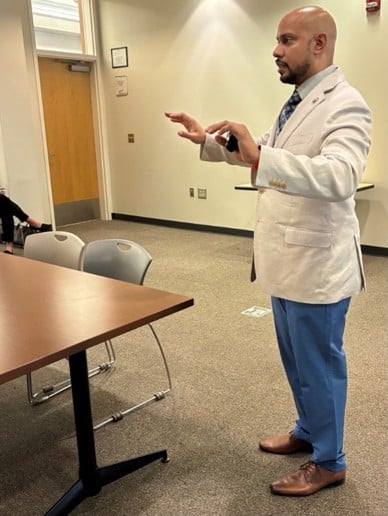
Dr. Joseph Rampersad talking about how to engage students at Pitt Community College.
“If the student trusts you, you can get them to go far beyond anything they can possibly imagine,” Rampersad said.
The first step, of course, is understanding the student.
Rampersad suggests you take what a student says, interpret what they really mean, and then identify what they need.
For example, if a student says they aren’t college material, one interpretation could be that they do not see themselves belonging on a college campus. In that case, what they might need is someone who is compassionate and understanding and can guide them through the college-going process.
Another common phrase is “I need to make money.”
An interpretation of that could be “My immediate circumstances are shaping decisions.” And what the student may need is an understanding of how credential pathways can connect them with employment more quickly than a traditional college route might and they can stack credentials over time, as they need them to advance in their career.
But Jayla Council, an Outreach Specialist with Pitt Community College who attended one of Rampersad’s sessions, said it’s also important just to relate to students.
“I feel like you can connect with a student based on your experience,” she said.
She was a transfer student herself, and many of her students want to transfer from a community college to a four-year university. So, she tells them about her experience. She tells them about being scared.
“Once they know you went through the same thing and you’ve been in their shoes, it helps kind of open up that conversation,” she said.
Crucial Conversations
When starting a conversation with students, the way you listen to them is important. You don’t want them to shut down.
Rampersad suggests a question ladder that starts safe before progressing to identifying barriers and next steps.
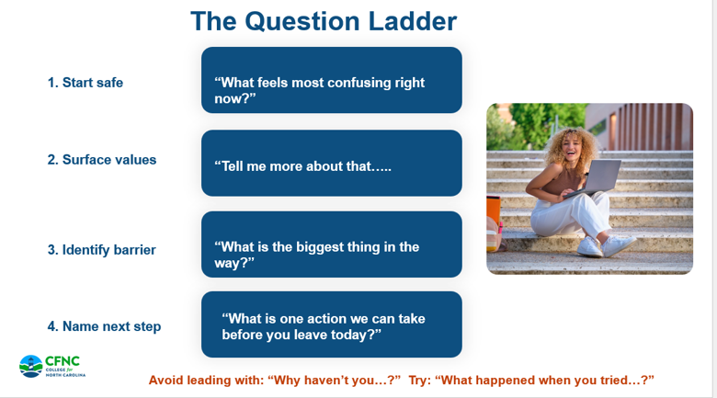
But just as important as interpreting what a student is saying is knowing how what you say could impact a student.
Things like, “You missed a deadline,” “You need to be more motivated,” or “Just fill it out,” can make someone defensive. Instead, you might say “Let’s look at what options are still open,” “What would make this feel worth your time,” or “Let’s complete the first step together.”
“Your tone can change the activity, it can switch the conversation from negative to positive,” he said. “You’ve got to be so careful with students.”
And there is no one size that fits all when it comes to students. Different students will need different levels of help.
Advise NC Next Step Adviser Atonio Odom attended Rampersad’s session at Pitt Community College. He said he has some students who talk to him for a few minutes and then go and do whatever they need to do to take the next step. But some students require more dedicated attention.
“Some of those students you might actually have to sit through and literally hold their hand through the whole thing, and that’s ok,” he said.
The Three Es
Ultimately, an education professional’s goal is to get students onto a path, to have a plan. It doesn’t necessarily matter what that path is, so long as they know how to traverse it.
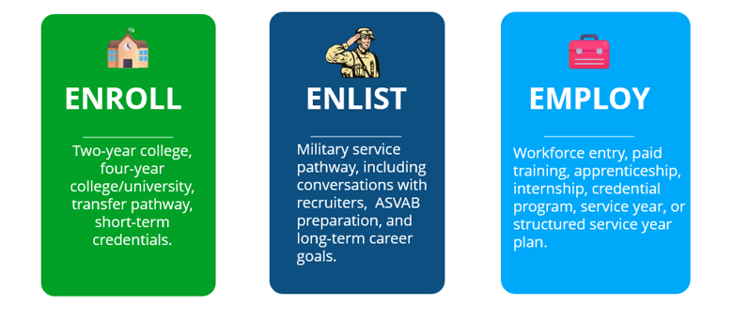
A good way to frame it is through the three Es: Enroll, Enlist, and Employ.
But it’s also a good idea to make clear that none of those Es is mutually exclusive.
Brittany Privott, CFNC Associate Outreach Director for Southeast North Carolina, said the different Es can actually work together, with one leading to another. For example, enlisting in the military can ultimately end up being a way to pay for college. And college can, of course, become a pathway to employment.
“I usually ask students, ‘What E do you want to start on?’” she said. Helping students know this is just the first step in a life plan takes some of the pressure off thinking they have to have their whole life figured out.
Rampersad emphasized that there are always options out there for students, but what they often lack is exposure. It’s the education professionals’ job to provide it.
The Start of the Conversation
Students sometimes enter the conversation about their post-secondary journey afraid to make a mistake, Rampersad said. But it’s important to share with them that there is no one set path to get where they’re going. They may make a decision and then change their mind a few years down the road. They may have many different types of careers in their lifetime.
But if you can establish a rapport with a student, identify what they’re feeling and saying, and help them find a next step, you can get them on the path to success. And that all starts with breaking through their barriers. No matter what roadblocks a student is throwing up, keep trying.
“Disengagement is not the end of the conversation,” Rampersad said. “It’s the beginning.”