CTE: Helping Students Find their Future

CFNC Associate Outreach Director Takeila Hall visiting the Scholastic Esports Alliance table at the NC CTE Conference in July 2026.
When Derrick Fogg began working as a Career and Technical Education (CTE) teacher back in 2006, things were different. He had to attend the annual summer CTE conference every year to receive a CD with curriculum on it. Now, he can just hop on Moodle for access. And when he was a student himself, the term Career and Technical Education wasn’t even how people referred to the field.
“We called it vocational back then,” he said. “We can’t outlive that term.”
Things are very different now.
For the 2024-25 school year, North Carolina had more than 450,000 students participating in CTE programs, with almost 80,000 designated as Concentrators, according to the North Carolina Department of Public Instruction (DPI). DPI defines a Concentrator as “a student who has successfully completed a Concentrator course in an approved Career Pathway. Concentrator course is a second- or third-level course in the Career Pathway (CPPOS) that builds upon technical skills acquired in a prerequisite course.”
CTE Concentrators graduate high school at a rate of 99%, which is more than 10 points higher than the overall NC cohort graduation rate of 88%.
According to NCCareers.org, CTE “empowers all students to be successful citizens, workers and leaders in a global economy. CTE gives purpose to learning by emphasizing real-world skills, essential employability skills, industry credentials, and practical knowledge through curriculum and work-based learning such as internships.”
Why CTE?
Sherry Peek, a middle school Career Development Coordinator for Buncombe County Schools, says the benefits of CTE for students are manifold.
She said that through CTE, students can start getting a sense of their interests and motivations earlier in life. She added that the goal is to make sure students are “in a good place. They’re not in debt. They’re doing something they enjoy, and they can build on that and grow.”
She and her twin sister grew up in the home of blue-collar parents. She went into family consumer science while her sister went into health occupations. Peek was in the classroom teaching CTE for 35 years before moving to her new role.
She said that whether or not a student goes to college is up to them, but they should be aware of all their options.
“What we’re really trying to do in Buncombe County is raise exposure to what’s out there so that students get an opportunity to see jobs that they wouldn’t otherwise,” she said.
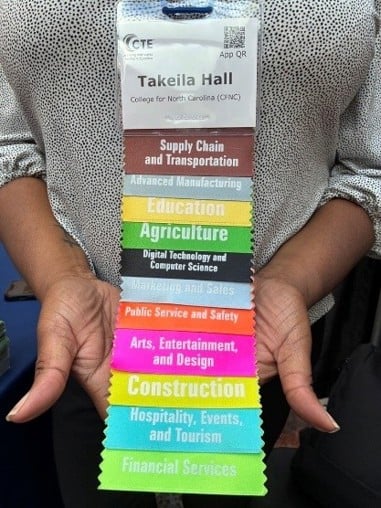
CTE field ribbons handed out at NC CTE Conference
Peek and Fogg both attended the NC CTE Conference in Winston-Salem July 13-17. It was held by NC DPI in collaboration with the NC Association for Career and Technical Education. In addition to the workshops and talks held during the conference, the Benton Convention Center, where it was held, was lined with booths from a multitude of CTE vendors trying to provide information about their fields and products.
The Variety of CTE Fields
Jeff Allen, Chairman of the Education Foundation of the North Carolina Society of Surveyors, was one of those vendors. At his booth, you could see the sophisticated way that modern technology is used to survey a landscape like the one he built out of sand and put on display for conference-goers.

Equipment hanging above the sand overlayed the landscape with topographical lines that represent things like the elevation and shape of the terrain.
He said the larger emphasis on CTE in education today is good not just for students but also for professions such as his.
“I think CTE is providing us an avenue of reaching kids,” he said. “Because before CTE, the surveying profession was just largely overlooked and misunderstood.”
He said there are seven technical schools in North Carolina that offer associates degrees for surveying, and one four-year university that offers a bachelors.
The difference between the two degrees is a matter of experience. With a four-year degree, a student still needs to get two years of field experience under a licensed surveyor before they can take the test and get their own license. With a two-year degree, they would need to get four years of experience.
But he said even with a two-year degree, a surveyor can move up the ladder quickly. And students who enter the field have diverse opportunities to look forward to, he said.
“You can travel with this knowledge. You can go anywhere in this country. You can go anywhere in this world,” he said. “Surveyors are making good money.”
One of the most valuable aspects of CTE education in high school is the jump start it can give students who participate. Nina Walls, Rockingham County Schools CTE Director, said students can be ready to work directly after graduation.
“Students can now leave high school with credentials, and we’re getting them workforce ready to go into apprenticeships, pre-apprenticeships, or directly into the workforce,” she said, adding later: “Those opportunities didn’t exist 25 years ago.”
And going into CTE doesn’t necessarily restrict high school students to a certain academic track.
Barry Carver teaches supply chain logistics in the CTE Department at Western Guilford High School. He says he gets students with all different academic aspirations.
“We have students who may just want to go into the workforce. They may want to go into the workforce and combine that with a two-year college. And we have students who are staying in the same field who are going into a four-year college,” he said. “There are many different pathways.”
And fields like his are the drivers of the modern economy. Any product being sold involves supply chain, he said. Even the shirt you’re wearing as you read this.
“It was probably made somewhere overseas, so it had to get here to the United States. And it has to get to whatever retailer that you bought it from,” he said. “Someone has to manage that whole process.”
Aligning Education with Industry
But while opportunities abound in CTE, students aren’t always taking advantage of them.
MyFutureNC has a page on its website where it tracks labor-market alignment. These data show how well degrees received by students match up with the requirements of job openings. While the state overall is at 84% alignment, that percentage varies quite a bit depending on where in the state you look.
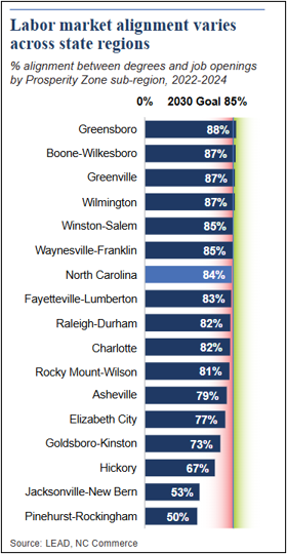
Courtesy of MyFutureNC
This is important because, according to MyFutureNC, employers in some sectors struggle to fill their openings and half of today’s occupations are likely going to transform a lot in the near future. Demand for employees with technical skills is only going to increase.
Bogg said that in CTE, it’s all about helping students grow a trade.
“If you look at it now, you don’t have a lot of people being electricians or HVAC, and it’s 400 degrees outside,” he said. “So, when the air conditioner breaks, everyone is looking like “What are we gonna do?”